








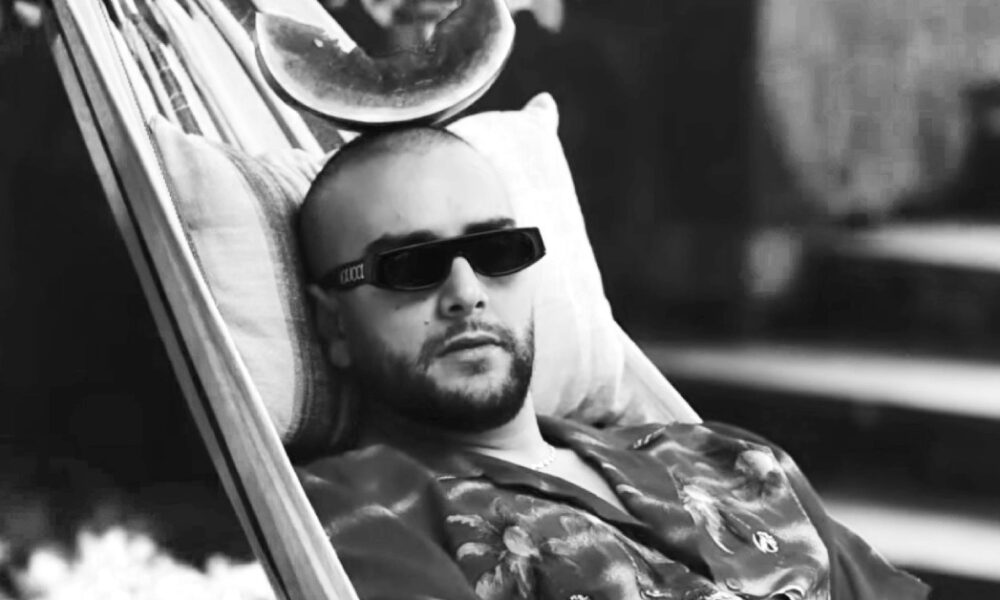
 Draganove, Moroccan rapper and producer, known for his signature dark sunglasses and genre-defying sound.
 There is something unsettling about Moroccan rapper Draganov. He always sees Morocco — and the world — from behind the dark shields of his sunglasses. No one can read what the universe has done to this man’s eyes. No one can catch a flicker of joy through those tinted lenses, or decipher the story he refuses to tell. And yet, sometimes, in his song lyrics, the glasses come off. And when they do, he says everything — about the city, about people, about love and music, hope and memory and heartbreak. When the questions about the dark lenses became too relentless, he answered with the only currency he trusts: a song. In Bon Courage, he said it plainly: “My time to shine has come.. sons of whores don’t deserve a glance from me.. that’s why I hide my eyes behind my glasses”.
Table Of Content
“They Won’t See My Tears Until I Die a Man”: The World According to Draganov
Every person carries their own key to reading this world. Tupac found his when he understood the street. Diam’s found hers wandering through Africa. Eminem found his when he decided to say out loud everything others were afraid to whisper. So when did Adnan Mahyou — the real name behind Draganov — finally understand this world?
Was it the year he was born in Oujda, in Morocco’s eastern reaches, back in 1990? Or the day he chose the name Draganov over the name his family gave him? No one knows. Maybe it happened when he founded his first group, The Kings 4, in 2008. Maybe when he began working alongside Wegz, El Grande Toto, and Manal. Maybe.
They won’t see my tears until I die a man… Today, it’s time to shine. Time to stack the dirhams
But today, there is no doubt: Draganov understands. And he says everything — in spite of the glasses, in spite of the frame that keeps the truth of his eyes from view. “I’ll start by cleaning up this filth… starting with those closest to me”, he raps in Bon Courage, then adds: “Even if I fall, I won’t let them see me cry”. And he doesn’t stop there — echoing Tupac, Diam’s, Eminem: “They won’t see my tears until I die a man… Today, it’s time to shine. Time to stack the dirhams”.
From Oujda to Casablanca: How Draganov Built His Career
In one of his rare radio interviews, a host asked him about the beginning. For a moment — without removing his glasses — his eyes appeared. They surfaced when he started talking about a long train journey across Morocco, and a strange encounter with an English traveler of Indian origin.
The train moved. A conversation began between two strangers. After many exchanges, Draganov admitted something raw: “Everyone I was close to — I can no longer find them around me”.
The British-Indian man, a Muslim, didn’t offer sympathy. He asked a question no one had ever asked: “How does God communicate with you?”.
The boy from Oujda had no answer. The traveler didn’t wait for one. He continued: “God communicates with us when we lose our relationships, when we lose the people closest to us. That is the first sign — God telling you to change where you are living”.
Draganov didn’t wait long after that train ride. Seven months later, he packed his bags and landed in Casablanca. Within a year, he had opened his first recording studio. A new chapter began — for an artist, producer, and rapper who is deeply, fiercely in love with what he does.
The numbers confirm the story. Nearly one million listeners stream his music on Spotify every month. His videos on YouTube have shattered every benchmark: Tach — 52 million views. 3dabi — 37 million. Wili — 42 million.
Tach, Rick Rubin, and Draganov’s Creative Philosophy
Many people only discovered Draganov seven months ago, when the video for Tach dropped and caused a storm across Moroccan and Algerian social media. The reason: an Algerian artist appeared in the clip, dancing.
Once again, Draganov put on his dark glasses and turned his back on the noise. He was unbothered. When pushed to comment, he answered the way he always does — through philosophy: “I follow the school of Rick Rubin”.
He elaborated: “That American producer approached the creative space with enormous nobility. It’s not a problem to walk into a studio and come out with a single word — that alone is an addition to the world”. The idea for Tach, he said, was born from exactly that spirit — a refusal to bow to pressure. “I’ve always loved Raï. I always wanted to work with Raï. But I kept telling myself: the rap purists will come for me and say, ‘How can a rapper sing Raï? That’s not rap!'”.
In the middle of all that chaos, Draganov spoke from behind his lenses with characteristic calm: “Either we follow the school of Rick Rubin, or we follow the school of zelt — and in Moroccan Darija, that word means broke in your wallet and broke in your mind at the same time. Follow that crowd, and you’ll stay both”.