








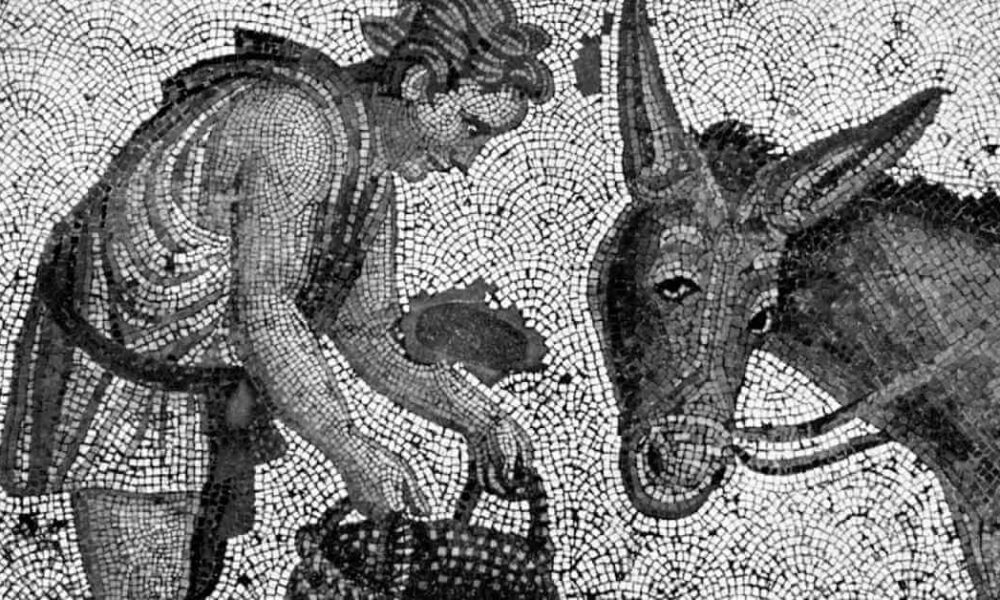
 Metamorphoses, known as The Golden Ass — the only Latin novel from antiquity to survive in its entirety, written by Amazigh author Lucius Apuleius around 160 CE.
 Nearly 2,000 years before the modern novel existed, an Amazigh philosopher from North Africa gave the world its oldest surviving work of prose fiction. His name was Apuleius — and it’s time you knew it.
Table Of Content
Around 160 CE, in the intellectual heart of the Roman Empire, a North African writer named Lucius Apuleius — known in his native Amazigh tongue as Afulay — completed a sprawling, bawdy, philosophically rich work he called Metamorphoses. History would remember it as The Golden Ass. Scholars recognize it today as the only Latin novel to have survived from antiquity in its entirety — and one of the strongest contenders for the title of the world’s first novel.
The premise is deceptively simple: a curious young man named Lucius, obsessed with magic, accidentally transforms himself into a donkey while attempting a spell. What follows is a picaresque journey across the ancient Mediterranean — through robbers’ dens, corrupt households, and pagan temples — until the Egyptian goddess Isis finally restores his human form. Apuleius himself sets the tone from the very first page:
“Let me weave together various sorts of tales — I’ll make you wonder at human forms and fortunes transfigured, torn apart but then mended back into their original state”.
Beneath the comedy and the ribaldry lies something far more ambitious: a meditation on human folly, spiritual redemption, and the price of unchecked curiosity.
Who Was Apuleius? The Amazigh Writer Who Invented Storytelling as We Know It
Apuleius was born around 124 CE in Madauros — present-day M’Daourouch in northeastern Algeria — a Roman colonial city nestled in the hills of ancient Numidia. He described himself as “half-Numidian, half-Gaetulian”, proudly claiming his Amazigh roots even as he mastered both Latin and Greek. His father was the chief magistrate of the colony. He went on to study in Carthage and Athens, immersed himself in Platonic philosophy, and traveled across Italy, Asia Minor, and Egypt before settling in Roman Africa.
His life rivaled his fiction in drama. Stranded in Oea — modern-day Tripoli — while ill, Apuleius was nursed back to health by an old friend, and ended up marrying that friend’s widowed mother, a wealthy woman named Aemilia Pudentilla. Her outraged relatives promptly accused him of winning her affections through witchcraft, a capital offense under Roman law. His defense, delivered before a proconsul in Sabratha around 158–159 CE and later published as the Apologia, became one of the most celebrated legal and literary documents of Roman Africa. In it, Apuleius reframed his alleged “magic” as rigorous scientific experimentation — the methods of Aristotle and Hippocrates, not sorcery — and demolished his accusers with razor-sharp wit.
The Golden Ass: A Novel That Shaped World Literature
The Golden Ass — spanning 11 books and featuring the timeless embedded myth of Cupid and Psyche — went on to shape Western literature in ways that are rarely acknowledged. Boccaccio drew from it for The Decameron. Shakespeare borrowed its central transformation for A Midsummer Night’s Dream. Machiavelli adapted it as a poem. Collodi echoed it in Pinocchio. C.S. Lewis retold the Cupid and Psyche myth in Till We Have Faces. Even Kafka’s Metamorphosis carries its DNA.
Augustine of Hippo — himself a North African, born just a century later in the same region — read Apuleius obsessively, and scholars note that the confessional tone of Augustine’s Confessions bears the unmistakable imprint of The Golden Ass. Augustine was so unsettled by Apuleius’s power that he attacked him repeatedly in The City of God. As Apuleius himself wrote of the human condition:
“Stupid people always dismiss as untrue anything that happens only very seldom, or anything that their minds cannot readily grasp.”
It is a line that reads as freshly today as it did in the second century.
A Legacy Hidden in Plain Sight
Yet Apuleius remains largely absent from the literary canons taught in Western schools — a footnote where he deserves a chapter. His Amazigh identity, rarely foregrounded in mainstream history, complicates the comfortable narrative that positions classical civilization as exclusively European. The first novelist in recorded history was not Roman, not Greek — he was a proud son of North Africa.
The exact date of his death is unknown. No records of his life survive beyond 170 CE. But his novel endures — the oldest complete work of prose fiction the world possesses, written by a man who mastered the empire’s language and used it to tell a story entirely his own.