








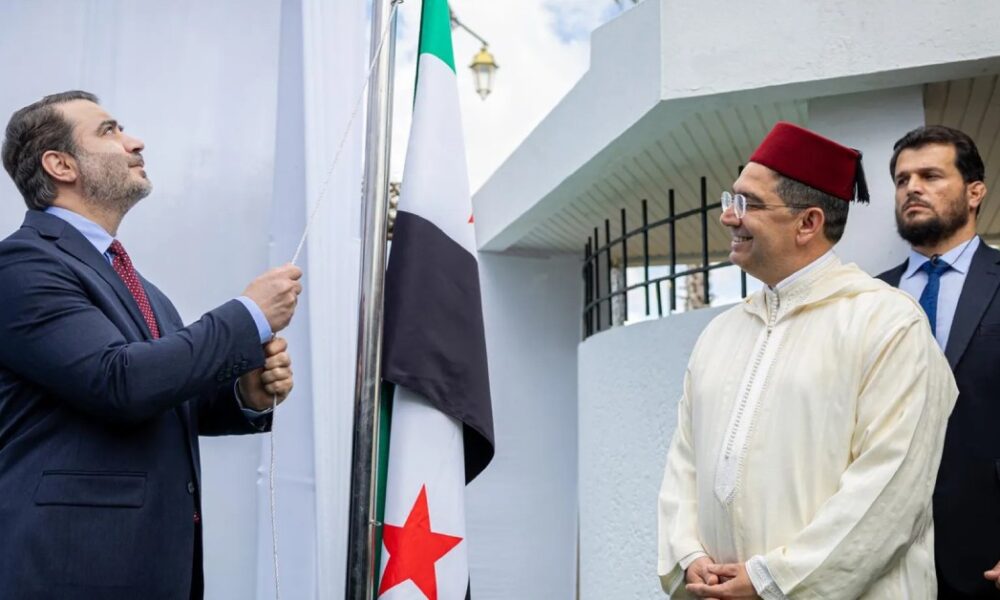
By Oussama Belfakir — Rabat
The image that circulated through national and international media — Syria’s new Foreign Minister Asaad al-Shaibani extending his hand to Nasser Bourita in the corridors of Morocco’s Foreign Ministry — was far more than a diplomatic formality. It was, in the most precise sense of the term, a death certificate: the formal closure of half a century of tension between the Ba’athist order and the Kingdom of Morocco.
The reopening of the Syrian embassy in Rabat, coupled with Damascus’s unambiguous recognition of Moroccan sovereignty over the Sahara, marks the moment geography finally reasserted itself over ideology. It brings to an end decades of what can only be described as political ingratitude — a sustained posture of hostility from the Assad dynasty toward a country whose soldiers had bled on Syrian soil. Their graves remain in the martyrs’ cemetery of Al Qunaitra, silent witnesses to a sacrifice that the Ba’ath regime chose, for fifty years, to repay with antagonism.
A History Written in Bad Faith
This dramatic shift cannot be read in isolation from a history laden with grievances. For decades, Hafez al-Assad — and after him his son Bashar — viewed the Moroccan monarchy through a lens of ideological suspicion, choosing instead to entrench themselves within the so-called “radical axis” steered by Algeria’s military establishment and Gaddafi’s Libya. It was an alliance built not on shared interests, but on shared hostilities.
When Bashar al-Assad fell, so too did the last fortress of a “radical Arab nationalism” that had spent decades treating the Moroccan monarchy as its ideological antithesis. The collapse of the Ba’ath regime on December 8, 2024 was not merely a change of leadership — it was the death announcement of an era of chronic hostility, one that had been prosecuted against Morocco’s national interests with a consistency that outlasted even its own logic.
The collapse of the Ba’ath regime on December 8, 2024 was not merely a change of leadership — it was the death announcement of an era of chronic hostility.
Historically, the relationship between Rabat and Damascus was never merely a matter of competing interests — it was poisoned at its root by ideology. In 1973, Morocco dispatched its Golan contingent, sending soldiers to fight and die on Syrian soil in defence of Arab solidarity. Seven years later, Hafez al-Assad’s response was to recognise the Polisario “republic” in 1980 — a move that stands as one of the more cynical acts of diplomatic betrayal in the modern Arab world.
Damascus’s recognition of what Morocco has always called the “phantom republic” was nothing more than a forward-flight policy — an attempt by the Ba’ath regime to weaponise Morocco’s territorial integrity as a tool of regional leverage. It was a cynical gambit that served no Syrian national interest, brought Damascus nothing but deepening isolation, and cost the Syrian people dearly in the end.
When Bashar al-Assad inherited power in 2000, he inherited his father’s instruments of tension — not his opportunities for correction. Morocco extended overtures on multiple occasions, each one met with the same cold ideological calculus that had defined the relationship since 1980.
Morocco’s decision in 2012 to host the “Friends of the Syrian People” conference and formally recognise the opposition as the legitimate representative of the Syrian nation was not, as some suggested at the time, a reactive political gesture. It was a considered strategic bet — placed on the inevitability of change in Damascus, and on the side of the Syrian people rather than the regime that was destroying them.
Geography Defeats Ideology
With the Syrian embassy reopening in Rabat under new leadership, Morocco closes a parenthesis of tension that had remained open for fifty years — a chapter defined by ideological obstinacy on one side, and patient strategic clarity on the other.
Syria’s recognition of Moroccan sovereignty over the Sahara is not merely a goodwill gesture toward Rabat. It reflects a deeper and more consequential understanding: that Syria’s future stability runs through alliance with serious, grounded Arab states, and requires breaking free from a dependency that had reduced Damascus to little more than an echo chamber for the ambitions of Algeria’s Presidential Palace.
Syria’s future stability runs through alliance with serious, grounded Arab states, and requires breaking free from a dependency that had reduced Damascus to little more than an echo chamber.
The Bourita-Shaibani meeting carries layered messages for both domestic and international audiences. Morocco — which aligned itself with the Syrian people’s demands as early as 2011, and whose former Prime Minister Saadeddine Othmani described the Assad regime as “incapable of renewing itself” — has today been vindicated. Its bet on inevitable change was not wishful thinking. It was political foresight.
With the fall of the Assad regime, the Polisario Front and its Algerian patron have lost their last ideological stronghold in the Arab Mashreq. Algeria now faces a diplomatic isolation of unprecedented depth. The “resistance” card — long deployed to justify supporting the fragmentation of already fractured Arab territories — has finally been played out. The hand is empty.
As Syria shakes the dust of Ba’athism from its diplomacy, it chooses to re-enter its Arab depth through the gate of Rabat — and in doing so, signals an understanding that national sovereignty is indivisible, and that supporting separatist movements was a historical sin whose price was paid most dearly by the regime that committed it.
The conclusion that today’s landscape imposes is this: the new Syria — or more precisely, the al-Sharaa administration — appears genuinely freer from the complexes of the past, and more lucid about where its interests lie. The resumption of relations with Morocco is not a diplomatic formality. It is the foundation of a new realist axis — one built on mutual respect for territorial integrity and a shared rejection of the politics of destabilisation that defined the previous era.
As Syrian diplomats prepare to take up their posts in Rabat, an international conviction continues to solidify: Moroccan sovereignty over the Sahara has become an irreversible geopolitical fact. The capitals that yesterday positioned themselves as Morocco’s adversaries now find themselves compelled to acknowledge what they once denied — not out of affection for Rabat, but because the logic of statehood and shared interest has proven, in the end, far more durable than the slogans of a Ba’athism that history has now consigned to the wind.