






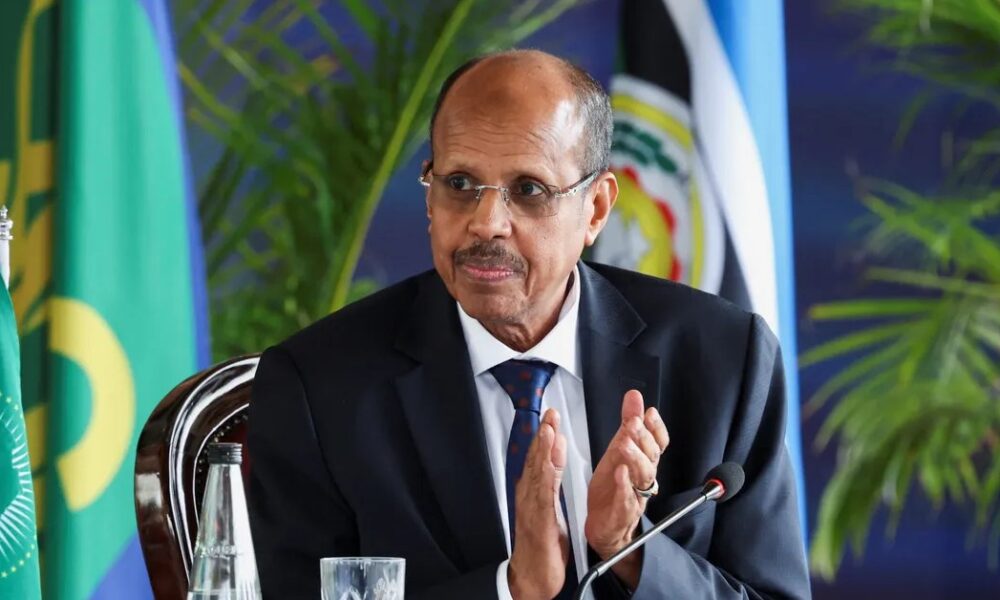
 Chairperson of the African Union Commission Mahmoud Ali Youssouf.
 The foreign ministers of nineteen Arab and Muslim-majority countries issued a joint statement condemning in the strongest terms what they called “the illegal and unacceptable step” taken by the so-called “Somaliland” region in opening a purported embassy in occupied Jerusalem. Morocco was among the signatories, alongside Egypt, Saudi Arabia, Qatar, Jordan, Türkiye, Pakistan, Indonesia, Djibouti, Somalia, Palestine, Oman, Sudan, Yemen, Lebanon, Mauritania, Kuwait, Algeria and Bangladesh.
The statement declared that the move “constitutes a flagrant violation of international law and relevant international resolutions, and represents a direct infringement on the legal and historical status of occupied Jerusalem”. The ministers reaffirmed that East Jerusalem has been occupied Palestinian territory since 1967, and that any measures intended to alter its legal or historical status are “null and void and without legal effect”.
This constitutes a flagrant violation of international law and a direct infringement on the legal and historical status of occupied Jerusalem.
— Joint ministerial statement · 19 Arab and Muslim-majority countries · May 2026
The nineteen ministers also expressed full support for the unity, sovereignty and territorial integrity of the Federal Republic of Somalia, and their rejection of any unilateral measures that would undermine Somali sovereignty — a pointed rebuttal of Somaliland’s long-running bid for international recognition.
The AU’s blind spot on secession
The episode has thrown into sharp relief a contradiction within the African Union itself. In April, following Israel’s reported decision to appoint a diplomatic envoy to “Somaliland”, the AU Commission issued a formal statement expressing “deep concern” and condemning the move outright. The Commission reaffirmed the AU’s “unwavering respect for the sovereignty, unity, and territorial integrity of Somalia”, declared that the Union does not recognise Somaliland as an independent state, and warned that any unilateral recognition is “null and void” and risks undermining regional stability.
The language is unambiguous. The principle invoked is clear. Which makes the contradiction all the harder to ignore.
The African Union applies territorial integrity to protect Somalia — yet it seats the so-called “Sahrawi Republic” that the United Nations has never recognised, that no permanent Security Council member supports, and that the European Union refuses to acknowledge. An organisation that defends one country’s sovereignty while hosting an entity rejected by the international community is not applying a principle. It is applying a preference.
That preference is increasingly hard to sustain. Both China and Russia have declined to allow Polisario representation at major international summits, on the grounds that only UN-recognised states may attend. For Rabat, the message is unambiguous: a principle invoked selectively is not a principle — it is a policy.