






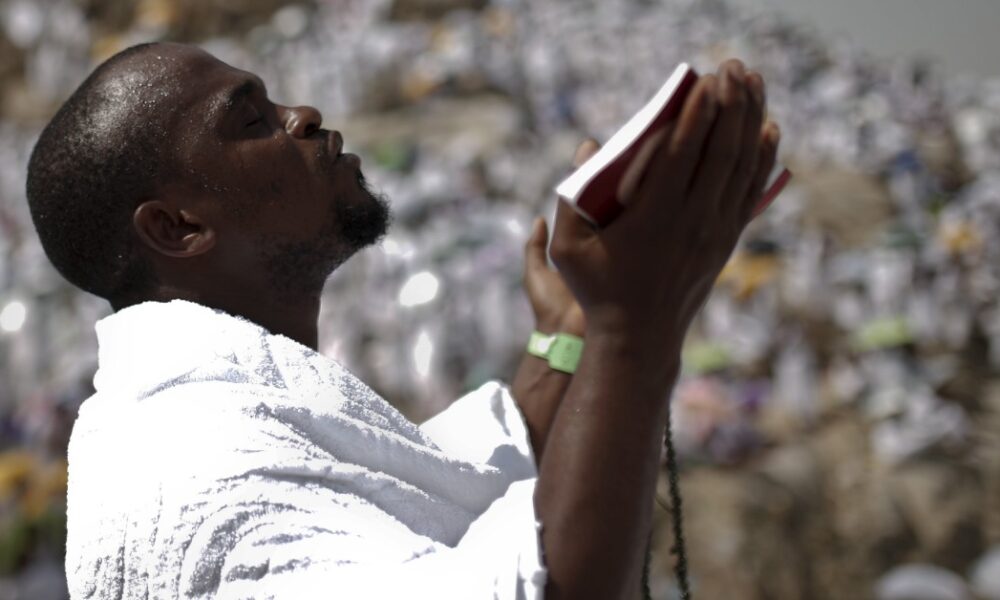
 White as far as the eye can see — and 45 degrees in the shade, if you can find any.
 From dawn, the faithful gathered to pray and recite the Quran on and around a 70-metre hill some 20 kilometres from Mecca — the site where the Prophet Muhammad delivered his final sermon. Wrapped in the ihram, two layers of white cloth that envelop male pilgrims throughout the rite, they came from every corner of the world, parasols in hand, walking toward one of the most spiritually charged moments in Islam.
“It is an indescribable feeling”, said Ahmoud Abou Elezz, a 35-year-old Egyptian engineer making the journey for the first time, a backpack on his shoulders and a parasol raised against the unrelenting sun. The hill offers little or no shade, leaving pilgrims directly exposed to the desert heat for hours. Medical teams were deployed across the site, while volunteers moved through the crowds distributing umbrellas.
This is where God gathers the community of believers, and reminds us that we can be united as peoples.
— Karim Hazem, Tunisian pilgrim, 40 · Mount Arafat, 27 May 2026
After Arafat, pilgrims will move to Muzdalifah, where they will collect pebbles for the symbolic stoning of the devil on Wednesday — one of the final rites of a pilgrimage that Islam considers an obligation for every Muslim who is physically and financially able to make it.
A pilgrimage under the shadow of war
This year’s Hajj unfolds against an unusual geopolitical backdrop. The American-Israeli war on Iran, which began on 28 February, and the resulting tensions across the Gulf region — struck for weeks by Iranian drones and missiles in retaliation — have cast a long shadow over the gathering. Some 30,000 Iranian pilgrims are on the ground, according to Iran Air as cited by the official IRNA agency — far fewer than the 86,000 initially expected, the shortfall a direct consequence of the conflict.
The diplomatic pressure is equally present. Donald Trump declared Monday that Muslim-majority countries, including Saudi Arabia, “should be obliged” to normalise relations with Israel as part of a peace deal — injecting fresh uncertainty into ongoing negotiations at the very moment the Islamic world’s largest annual gathering is under way.
For the pilgrims on the hill, none of that noise penetrates. “This is where God gathers the community of believers”, said Karim Hazem, a 40-year-old Tunisian, “and reminds us that we can be united as peoples”.
- Source: AFP