








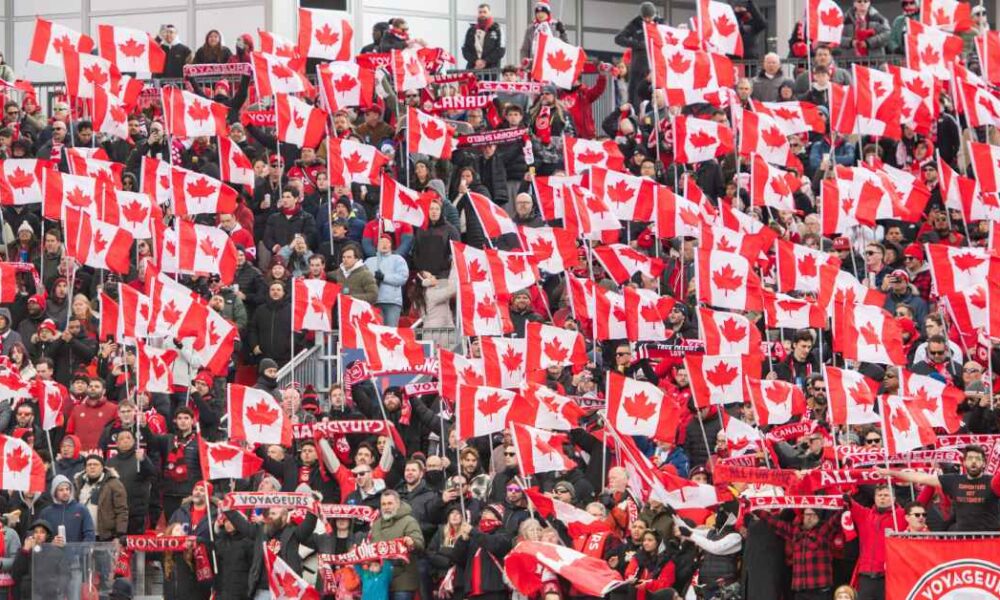
 Same tournament, different country, different feeling — Canada is ready for the World Cup, and it shows.
 Cross the border from the United States into Canada and the World Cup feels like a different tournament. South of the line: travel bans, immigration crackdowns, questions about ICE activity during the tournament, and the political weight of the conflict with Iran — whose team recently moved its training camp from Arizona to Tijuana. North of the line: excitement, civic pride, and a host nation that has spent years building toward this moment and is determined to enjoy it.
“The game belongs to everyone”, Canada Soccer President Peter Augruso said at the recent FIFA Congress in Vancouver. “It doesn’t ask where you are from, only how you play, how you lead and how you bring people together”. Speaking directly to the contrast with the United States — without naming it — Augruso added: “Our diversity hasn’t diluted us. It’s defined us. In a world that can feel divided, Canada stands proof that diversity isn’t a challenge to overcome, but a strength to celebrate”.
“People are ready for the World Cup to be in Toronto. I think until it’s actually here and people see it, it’s going to probably blow people away”. — Richie Laryea, Canada and Toronto FC defender · May 2026
That is not to say the tournament is without friction in Canada. A government watchdog has estimated the cost of hosting at roughly $1 billion for federal and local governments. There are concerns about the impact on marginalised communities, and ticket prices have drawn criticism. Trump’s travel restrictions — affecting World Cup participants Iran, Haiti, Ivory Coast and Senegal — raise unanswered questions about access for fans from those countries, wherever they arrive from.
Can Canada become a soccer nation this summer?
Toronto and Vancouver will host 13 matches between them. Canada’s opening ceremonies are set for 12 June in Toronto, where the national team plays Bosnia and Herzegovina, with Alanis Morissette and Michael Bublé among those performing. Defender Richie Laryea, who plays for Canada and Toronto FC, captured the mood on the ground: “When you go out and get a coffee or even in and around the hotel, people are excited”.
Canada has appeared in the World Cup only twice before — in 1986 and 2022 — and has never advanced past the group stage. This time, the team plays all its Group B matches on home soil: the Toronto opener, then Vancouver against Qatar on 18 June and Switzerland on 24 June. Coach Jesse Marsch, American-born and a veteran of Major League Soccer, has drawn a direct parallel to the 1994 World Cup in the United States, which he credits with creating the professional opportunities that defined his career. “What we need to do is make sure we’re providing more opportunities like that for players and coaches, so that in the future we can continue to elevate the game in this country”, he said.
Soccer is already the top sport among Canadians aged 5 to 17, according to the Canadian Fitness and Lifestyle Research Institute. Stars like Christine Sinclair and Alphonso Davies have raised the game’s profile significantly over the past decade. Whether this summer becomes the moment that fully converts Canada into a soccer nation may depend, as Marsch openly acknowledged, on how far his team goes. In Vancouver, at least, the comparison people reach for is not 1994 — it is the 2010 Winter Olympics, when Canada beat the United States 3-2 in hockey and the city erupted. “Maybe Vancouver will party like we did when Canada won the gold in hockey”, said Brent Stewart, kicking a ball in a Burnaby park with friends.
- Source: AP