






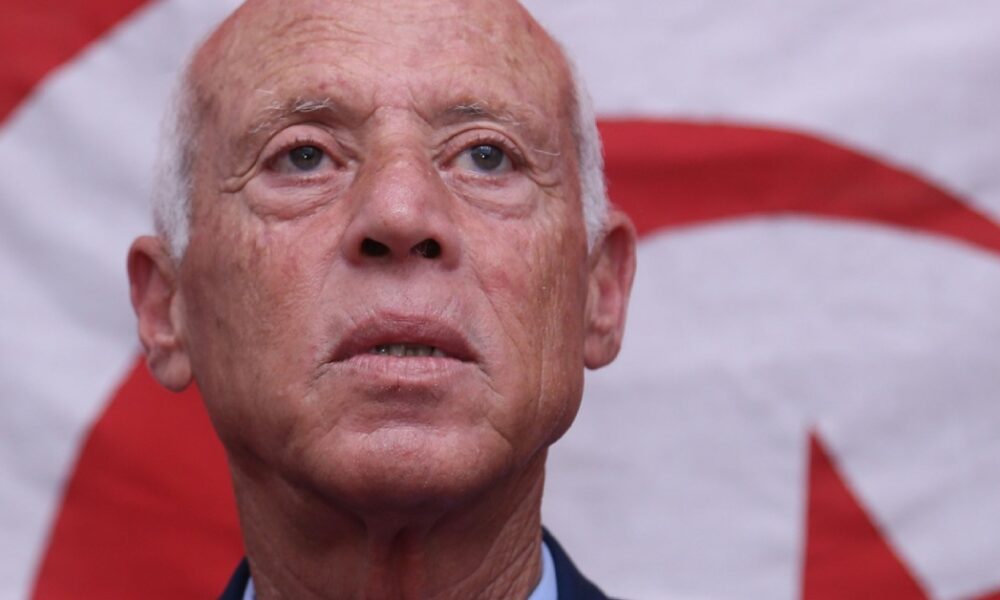
 Kais Saied — Tunisia's president at the center of a deepening democratic crisis.
 Two days before Tunisians took to the streets chanting “the people are hungry and prisons are full”, Amnesty International had already counted at least 25 civil society organizations hit with court-ordered suspension notices. The timing was not coincidental. It was a pattern.
What is happening in Tunisia under President Kais Saied is not a crisis of governance. It is the deliberate, methodical construction of a system designed to look legal while functioning as repression. Since dissolving parliament and ruling by decree in 2022, Saied has restructured the electoral commission — appointing all seven of its members personally — hollowed out judicial independence, and detained opposition candidates ahead of elections. Freedom House rates Tunisia’s electoral integrity at 0 out of 4 (Democratic Erosion Consortium, April 28, 2026).
On April 24, 2026, his government suspended the Tunisian League for Human Rights, the LTDH — a Nobel Peace Prize laureate, the oldest human rights organization in Africa, a pillar of the post-2011 democratic transition. The same day, journalist Zied el-Heni was detained for a Facebook post criticizing a court ruling against a fellow journalist (Democratic Erosion Consortium, April 28, 2026). The legal instrument used against him was not a press law. It was a cybercrime statute.
That choice of instrument is the point.
Law as a Weapon, Not a Shield
Banning the LTDH outright would have triggered immediate international condemnation and opened clear legal challenges. A 30-day administrative suspension, framed around technical compliance issues, is far harder to contest in court — and far easier to renew. By May 11, dissolution proceedings had already opened against Al Khatt, the organization behind independent investigative outlet Inkyfada (Amnesty International, May 11, 2026). Twenty-five other NGOs face the same trajectory.
Arresting el-Heni under an explicit press restriction would have made the crackdown internationally legible as an attack on journalism. Routing it through Article 86 of the telecommunications code reframes it as a routine criminal matter (Democratic Erosion Consortium, April 28, 2026). The repression is identical. The optics are sanitized.
This is the defining logic of competitive authoritarianism: elections continue, institutions technically exist, but the mechanisms of accountability are hollowed out until dissent carries an unbearable cost. The LTDH and el-Heni were not targeted despite their legitimacy. They were targeted because of it.
A Country Eating Itself
The May 16 protest in Tunis captured both dimensions of the collapse. Demonstrators carried banners denouncing the arrests of politicians, journalists, and civil society figures. They also criticized Saied’s failure to address Tunisia’s economic deterioration — sluggish growth, soaring prices, shortages of medicines and basic food items, crumbling public services (Reuters, May 16, 2026).
The bar association announced strikes over the erosion of judicial independence. The journalists’ union planned protests over imprisoned colleagues (Reuters, May 16, 2026). Amnesty’s Deputy Regional Director for MENA warned that legal and judicial mechanisms are being weaponized to suppress independent voices and undermine freedom of expression and peaceful assembly (Amnesty International, May 11, 2026).
Saied rejects this framing entirely, insisting his measures are necessary to rescue the country from chaos and corruption (Reuters, May 16, 2026).
Tunisia was the only Arab Spring country to build a functioning democracy. For a decade, it was the proof that democratic transition was possible in the Arab world. That proof has now been dismantled — not through tanks, but through cybercrime statutes and 30-day administrative suspension orders. The tools were always available. It just took a president willing to use them.
- Sources: Reuters (May 16, 2026), Amnesty International (May 11, 2026), Democratic Erosion Consortium / Suffolk University (April 28, 2026).