






 26 players. 19 born abroad. One nation. Oxford unpacks what Morocco's 2026 World Cup squad really says about the country behind it.
 As Morocco names its 26-man squad for the 2026 World Cup, a research paper published by the University of Oxford’s Centre on Migration, Policy and Society offers something rarer than match analysis: a serious attempt to understand what the Atlas Lions’ squad list actually says about the country that fields them.
Table Of Content
The answer, Oxford’s researchers suggest, is more layered than any football pundit has captured. Morocco’s squad is not simply a collection of talented footballers. It is a generational portrait of transnational mobility — parents who left for European factories, children who grew up in the suburbs of Amsterdam, Brussels and Lille, and a federation that turned that diaspora history into deliberate, winning strategy.
Of the 26 players named for 2026, 19 were born outside Morocco — up from 14 in the Qatar 2022 squad. Far from treating this as a tension to manage, Oxford’s analysis presents it as the carefully engineered outcome of a model two decades in the making.
A Strategy Built on Belonging, Not Just Eligibility
What distinguishes Morocco’s approach, the Oxford paper argues, is that it never reduced diaspora recruitment to a numbers game. The federation’s message to European-born players of Moroccan heritage was never merely “you are eligible”. It was, consistently: “you belong here, and there is a serious football project to be part of”.
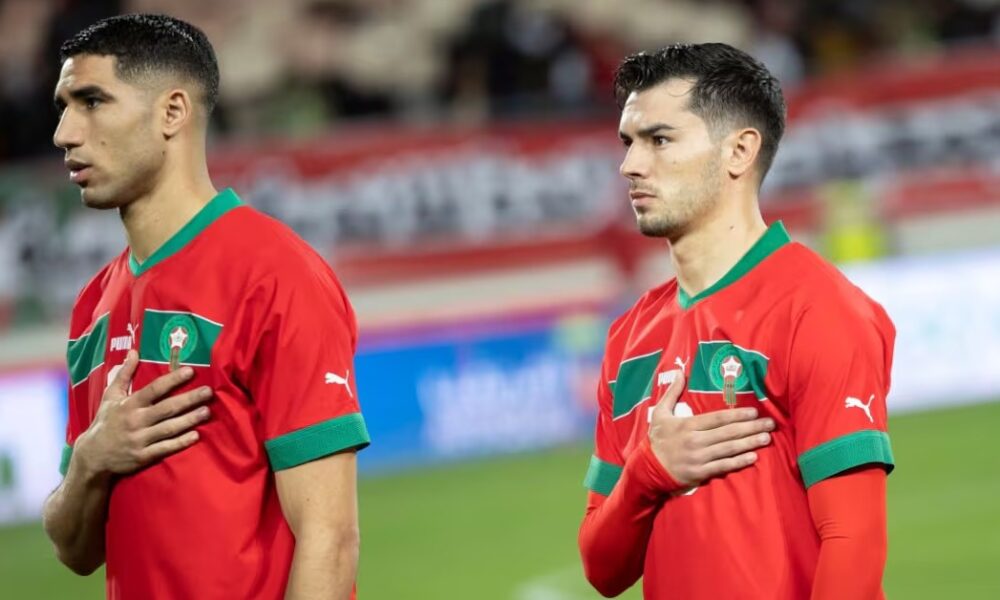
The case of Brahim Diaz — born in Málaga, developed at Manchester City, AC Milan and Real Madrid, capped once by Spain — illustrates the point with force. His decision to commit to Morocco was not the fallback of a fringe player seeking any available international pathway. It was a deliberate choice by one of the world’s most sought-after midfielders. His own framing — feeling “100% Spanish” and “100% Moroccan” — captures what Oxford calls “layered belonging”: an identity that does not demand choosing one country over another, but holds both simultaneously.
The inclusion of Ayyoub Bouaddi, born in France and developed at Lille, pushes that logic into the next generation. Morocco, Oxford notes, is now competing for future stars before their senior international identity is even fixed — a sign of a federation operating with rare long-term vision.
Oxford’s data complicates the simplest version of the story further. Between 2017 and 2026, of 61 diaspora players assessed, 54% opted for Morocco from the outset — without switching from another national setup. Morocco is not harvesting overlooked talent. It is mobilising a transnational Moroccan football identity rooted in decades of migration history and sustained institutional engagement.
Domestic Investment: The Other Half of the Story
The Oxford paper is equally careful to identify what makes Morocco’s model more than diaspora opportunism. The Mohammed VI Football Academy, sustained investment in training infrastructure, and a strengthened federation have given the project the institutional credibility that makes diaspora outreach believable. As FRMF president Fouzi Lekjaa put it: “The development of football in Morocco should be based on a three-pronged approach, focusing on facilities, talent and well-qualified staff”.
That credibility is the difference, Oxford argues, between a federation that attracts diaspora players and one that merely chases them.
What the Squad Tells Us About the Country
Oxford closes its analysis with an observation that extends well beyond football. Morocco is increasingly a country of immigration as well as emigration, with growing communities from Senegal, Mali, Congo and elsewhere putting down roots in Casablanca and beyond. The next generation of Atlas Lions, the paper suggests, may include players whose family stories feature not only Paris or Brussels, but Dakar or Abidjan — a national team of natives, homecomers and newcomers alike.
Morocco’s 2026 World Cup squad, Oxford concludes, is not merely a selection. It is a snapshot of how migration has already shaped the country — and a confident signal of how it intends to harness that story going forward.
Source: COMPAS, University of Oxford