





 A declassified U.S. cable reopens the historical file on the occupied Ceuta and the occupied Melilla in Morocco-Spain relations
 A declassified U.S. diplomatic cable, released in 2014, shows that Spain’s emeritus King Juan Carlos I said in 1979 he would be willing to consider ceding the occupied city of Melilla to Morocco within a relatively short timeframe, while suggesting that granting the occupied Ceuta a special international status, similar to the one Tangier held between 1923 and 1956, might be the more fitting solution for that city.
The document was first revealed by Spanish historian Charles Powell, director of the Elcano Royal Institute since 2012, in an essay titled “The First Ambassador of Democracy: Juan Carlos and Spain’s Foreign Outreach”, published in a collective book in 2017. Spanish daily OKDiario recently returned to the document, drawing renewed attention to it.
The details trace back to April 30, 1979, when Juan Carlos received U.S. Senator Ed Muskie, personal envoy of then-President Jimmy Carter, along with U.S. Ambassador to Madrid Terence Todman, at the Zarzuela Palace. The conversation lasted more than an hour and a half, and its contents were later recorded in a secret cable sent by the U.S. embassy to the State Department in Washington.
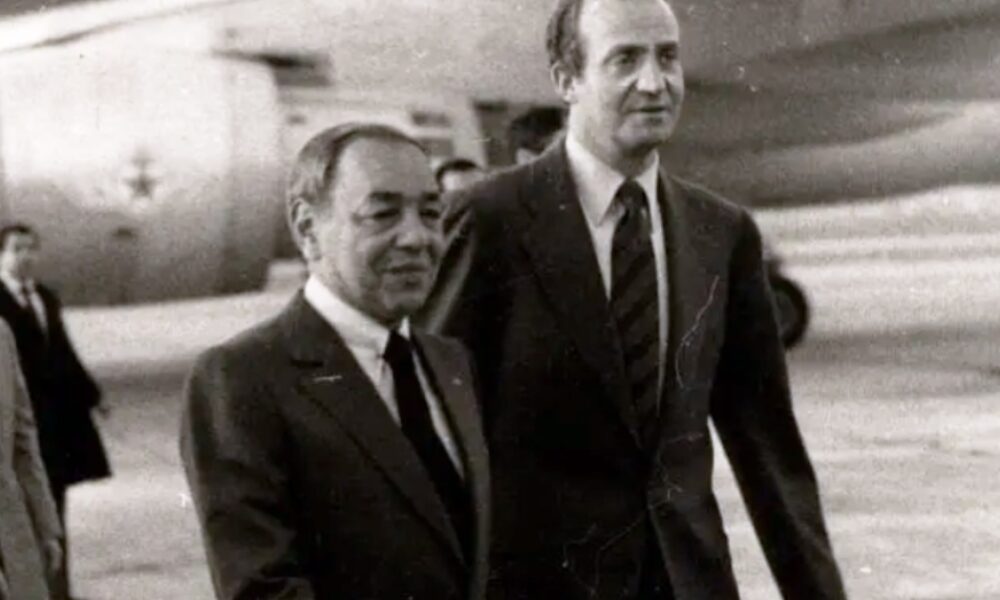
The king’s remarks came just four years after the Green March, at a time when Spanish-Moroccan relations were passing through a delicate phase, amid concern in Madrid over the possibility of mounting Moroccan pressure regarding Ceuta and Melilla.
What the Cable Says
According to the cable, Juan Carlos described the two colonies as “the big issue” between Spain and Morocco. He believed the occupied Melilla “could be ceded to Morocco within a relatively short time”, reasoning that only around 10,000 Spaniards lived there. He acknowledged that Spain’s military would object, but believed the discontent “would last only about two months” and that he could “control the situation”.
Regarding the occupied Ceuta, home to roughly 60,000 Spanish residents at the time, the king considered a direct handover to Morocco impossible. He proposed instead that “perhaps the best solution” would be a status similar to Tangier’s between 1923 and 1956, administered by a commission of several European countries, including Spain. He said he feared that, absent a solution, another Green March-style event could occur, which would create serious problems.
According to the document, the cable had been shown to Senator Muskie beforehand for review, and no objections or corrections from him were recorded. The cable carries the official notation confirming it was declassified by the U.S. government on March 20, 2014.
The document stresses that what Juan Carlos expressed at the time was not “an official proposal from the Spanish government, nor part of formal negotiations with Morocco”, but rather personal views and remarks made during a private conversation with American officials, in a politically sensitive context following the 1975 Green March, as Spain sought to carefully manage its relationship with the late King Hassan II.
- Source: oKdiario