





By Imad El Majdoubi — Casablanca
While ordinary Moroccans wait for a mature political vision — something capable of breathing life back into public institutions and offering real answers to worsening economic and social crises — the country’s political class keeps dragging the nation into absurdist theater instead. It’s a performance with only one destination: rock bottom.
Politics in Morocco has stopped being a contest of ideas. It’s become a bazaar. Party endorsements go to whoever pays the most, and loyalties change hands with no trace of conscience, let alone national interest.
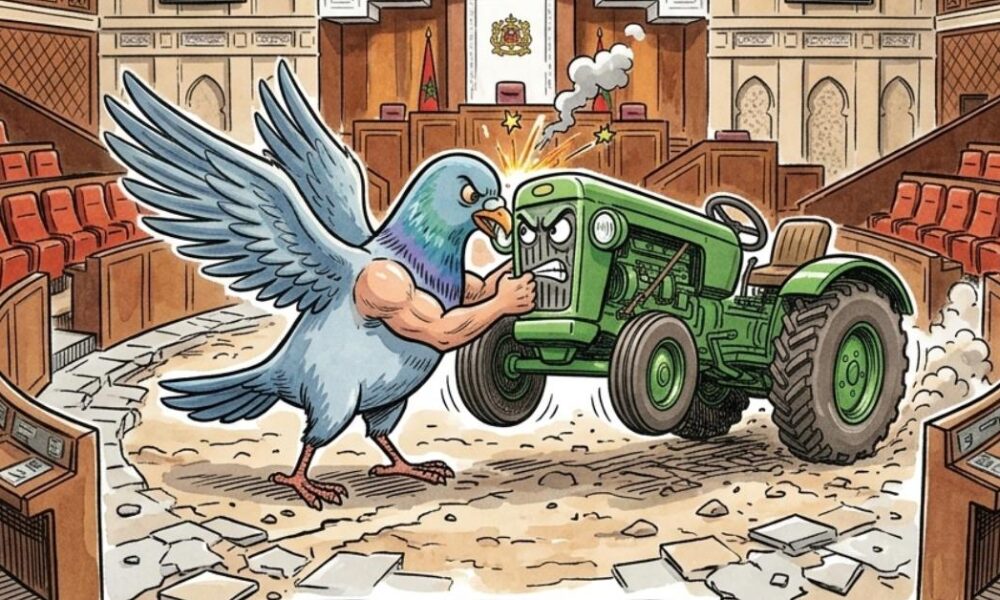
Take the recent statement from the National Rally of Independents (RNI), lashing out at its own supposed ally, the Authenticity and Modernity Party (PAM), accusing it of pressuring and poaching lawmakers. On its face, it looks like just another spat between coalition partners. Look closer, and it’s a symptom of something rotting at the core of Morocco’s party system.
Consider this: sitting lawmakers — still fulfilling mandates under one party’s banner — are already lining up to run for a rival party next election. Names like Hartoun, Joumani, Simo. This isn’t political maneuvering. It’s a scandal, plain and simple, and it guts whatever was left of fair competition.
How did we get here — to a politics reduced to trading personalities and bartering endorsements, instead of competing over actual solutions to people’s problems? And how do we square that with all the talk of “cleaning up political life” and “transparency”, when what’s actually happening on the ground looks nothing like either?
These parties — regardless of their labels or their claimed ideologies — have shown themselves to be little more than election machines. No ideology. No real vision for society. Just machinery built to win.
Watch how political figures move between party blocs before every election, like merchandise changing hands, and it becomes clear: these aren’t people with convictions. They’re operators — chasing opportunity, rent, immunity, whatever position keeps them relevant.
Even RNI’s attack on PAM, which escalated all the way to threats of legal action over the fight for local power brokers ahead of elections, tells its own story. It’s an admission, really — that party-building here has been hollowed out by patronage and by loyalties bought outright, and that “political competition” now just means a scramble for parliamentary seats.
This is exactly the kind of behavior driving citizens away from politics altogether. And who can blame them? How is an ordinary Moroccan supposed to trust a parliament, or a government, built on courting local notables by whatever means necessary — legal or not — under the old logic that the ends justify the means?
Morocco’s party politics is living through its lowest point. Vision is gone. Values have evaporated. What’s left is a fight over spoils, dressed up as democracy.
The public hand-wringing, the accusations of “poaching” activists and local figures — none of it hides the fact that the whole electoral process has been stripped of real democratic substance. No slogan is going to fix a tear this deep. Moroccan politics needs something closer to an earthquake: a real break from decades of treating voters like they don’t notice, an end to the “election merchants” and endorsement brokers who’ve dragged the country into a tunnel of shallow, decaying politics.
It’s time to say it plainly: party politics in Morocco, as it stands, is bankrupt. What we’re watching isn’t a rough patch. It’s the slow death of political practice itself — and of party politics most of all.