




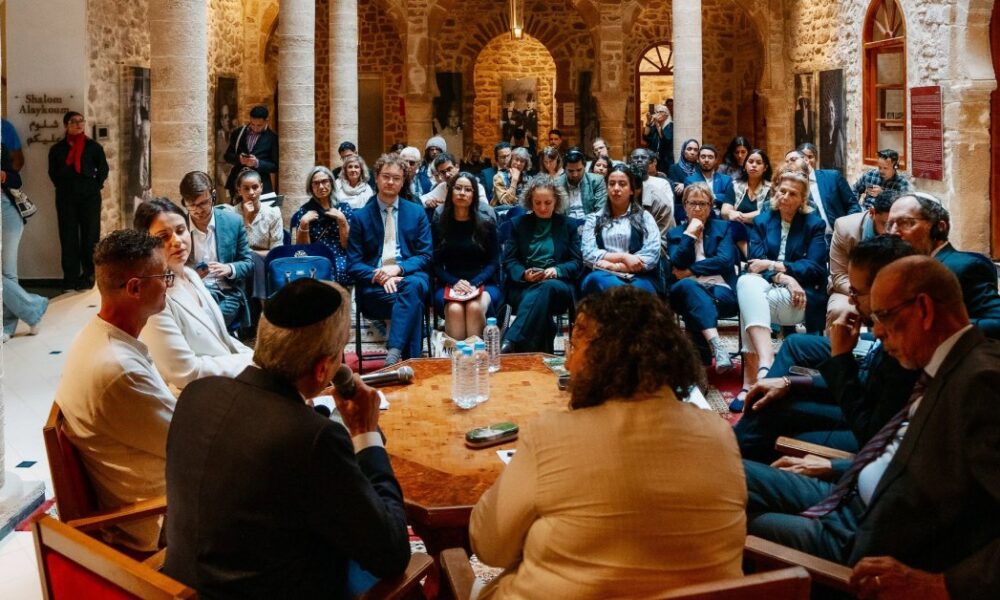
The first edition of the Mogador Essaouira Dialogues (MEC), held under the theme “Civilizations in Dialogue”, opened on Thursday, November 19, 2026, bringing together Moroccan and international figures to promote intercultural understanding, peaceful coexistence and dialogue between generations.
The event is a joint initiative of Moroccan Millennium Leaders (MML), the Konrad Adenauer Foundation (KAS) and the Essaouira-Mogador Association. It aims to establish an international platform for exchanging ideas on contemporary challenges and exploring ways to strengthen peace, mutual understanding and cooperation between societies.
The opening session highlighted Essaouira’s historic role as a meeting point for different cultures and religions. Speakers stressed that the city’s heritage of coexistence offers an important example at a time when international conflicts, social polarization and declining trust between communities are becoming growing concerns.
André Azoulay, Advisor to King Mohammed VI, described the launch of the event as an important step in strengthening Essaouira’s international profile. He said the initiative, the first of its kind in Morocco, could help consolidate the city’s position as a space for dialogue between cultures and civilizations.
Azoulay also highlighted the significance of the name “Mogador”, which reflects the city’s historical and cultural memory. He recalled Essaouira’s long-standing role as a place of human and cultural exchange, as well as its distinctive experience of peaceful coexistence between religious communities.
Abdeljabbar Rachidi, Minister Delegate in charge of Handicrafts and the Social and Solidarity Economy, focused on the role of traditional crafts in preserving cultural identity and transmitting collective memory across generations.
He said Moroccan civilization had been shaped by Amazigh, Arab, Andalusian, Jewish, African and Mediterranean influences, which have come together to form a shared national identity. Traditional artisans, he added, have played a central role in preserving and expressing this cultural heritage.
Rachidi also warned about the challenges digital platforms pose to intercultural dialogue, including misinformation, hate speech and the use of algorithms and artificial intelligence to deepen social divisions. At the same time, he pointed to the potential of technology to support cultural preservation, improve translation and encourage greater understanding between communities.
For his part, Steven Höfner, Resident Representative of the Konrad Adenauer Foundation in Morocco, warned that rising conflicts, polarization and disinformation were weakening trust between individuals and societies.
He argued that international discussions should give greater attention to values such as dignity, responsibility, trust and dialogue, alongside issues of security, sovereignty and power. He also stressed that preserving models of coexistence requires the active involvement of every generation.
Marouane El Hajjaji Idrissi, President of Moroccan Millennium Leaders, said the initiative was created to provide a space where people from different backgrounds could engage in open discussion and listen to one another.
He expressed the ambition to position Morocco as an international platform for dialogue between civilizations, drawing on Essaouira’s diverse cultural heritage. He also highlighted the role of young people, saying they should not simply attend discussions but actively help shape debates on peace, shared memory and the impact of digital transformation on human relations.
Soufiane Hmayni, President of the Essaouira-Mogador Association, said hosting the event reflected the city’s long history of openness, hospitality and coexistence. He emphasized the role of civil society in strengthening dialogue and connections between generations.
Other speakers also highlighted the links between cultural heritage, traditional craftsmanship and dialogue. Jalila Mersli, President of the Casablanca-Settat Chamber of Handicrafts and a member of Parliament, described Essaouira as a living space where history, craftsmanship and cultural diversity intersect.
Hassan Chmeiss, President of the Marrakech-Safi Chamber of Handicrafts and a member of Parliament, noted that cultural exchange has historically taken place not only through institutions and intellectual forums but also through markets, workshops and everyday interactions. He pointed to Essaouira’s cedar wood craftsmanship as an example of the city’s distinctive artistic heritage.
Meanwhile, Essaouira Mayor Tarik Othmani stressed that coexistence is part of the city’s everyday social experience, rather than simply a slogan. He called for these values to be passed on to younger generations through schools, neighborhoods and local community initiatives.
The opening session concluded with a shared call to turn intercultural dialogue into lasting action. Speakers emphasized that preserving shared memory and promoting peaceful coexistence require the involvement of public institutions, civil society, cultural actors and young people.
The launch of the Mogador Essaouira Dialogues reinforces the city’s ambition to serve as an international meeting point for cultural exchange, while highlighting Morocco’s role in building bridges between civilizations.