

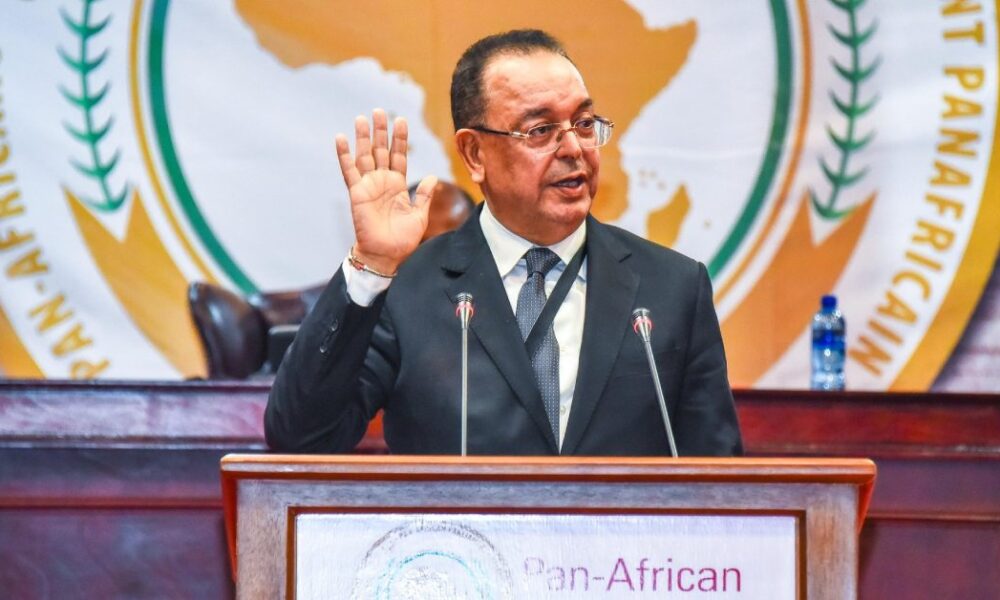
 Deputy Speaker Lahcen Haddad representing Morocco at the Pan-African Parliament
 By Badr Touasli
Not every defeat is measured in vote counts, and not every battle is settled by a protest statement or an angry post on social media. What unfolded inside the halls of the Pan-African Parliament (PAP) was more than a Moroccan candidate losing to an Algerian rival — it was a politically revealing moment, in the fullest sense of the phrase. It exposed the structural failings that continue to undermine the performance of a segment of Morocco’s parliamentary elite when the stakes are high on the African stage — a stage that has no patience for improvisation, superficial contacts, or rhetoric crafted for domestic consumption.
At 24 Saa/MT, and out of a sense of national responsibility, we have chosen not to lay out every detail — even though what has reached us from inside the corridors paints a picture far clearer than what official statements or social media wars would suggest. This story is bigger than talk of “procedural irregularities” or “external interference.” It is also bigger than the celebrations of Algerian media outlets that seized on the result to trumpet a political victory. The painful truth is that the battle was decided before voting day — in the backrooms of African diplomacy, in closed-door meetings, in the ability to forge alliances, win over delegations, and read the continental mood with precision.
Africa is not a space for sentiment, nor a stage for slogans. It is a continent governed by delicate balances, interlocking interests, soft networks, and the kind of sustained, patient diplomatic work that never makes headlines. Anyone who believes that Morocco’s positive image alone is enough to win battles within African Union institutions simply does not understand how politics on this continent actually works.
Algeria — whatever our differences with it — entered this contest with a cool head, intensive diplomatic groundwork, and long preparation. Morocco’s camp, by contrast, showed visible disarray from the moment a candidate was selected, through the management of the campaign, and right up to the final hours of the vote.
The Real Problem Is Not the Result — It Is Who We Send
What makes this even more painful is that some of those representing Morocco within continental institutions still approach Africa with an event-driven mindset rather than a strategic, cumulative one. There is a vast difference between a parliamentarian who excels at delivering speeches for the cameras, and one who can navigate an influence battle inside a complex African institution riddled with political landmines.
What happened must prompt both the state and political parties to fundamentally rethink how Morocco selects those who represent it at the continental level. The criteria can no longer be party seniority, internal power balances, media-friendly faces, leadership loyalties, personal ties, or family names. What matters now is diplomatic competence, negotiating ability, a genuine understanding of African political cultures, and fluency in the language of coalition-building within the African Union.
No one questions Morocco’s strength across Africa, nor the remarkable strides its diplomacy has achieved in recent years — particularly under the enlightened royal leadership. But the problem arises when some elected representatives fail to match that strategic vision and drive. When delegations become a liability rather than an extension of Morocco’s soft power, something has gone deeply wrong. Worse still, some of those who took part in this particular battle acted on impulse and reaction, at a moment that demanded the composure of professionals and the cool nerve of seasoned statesmen.
What happened at the Pan-African Parliament must not be buried under diplomatic niceties or wrapped in narratives of “conspiracy” and “targeting.” Morocco is too significant a nation to run from criticism, and too strong a state to fear an honest accounting of its own mistakes. As for the truth that many insiders across the African arena already know — and which 24 Saa/MT has chosen not to lay out in full detail for now — its headline is simply this: some of those entrusted with defending Morocco’s standing on the continental stage were not equal to the moment, and not equal to a country of Morocco’s stature in Africa. And that is all that needs to be said.