



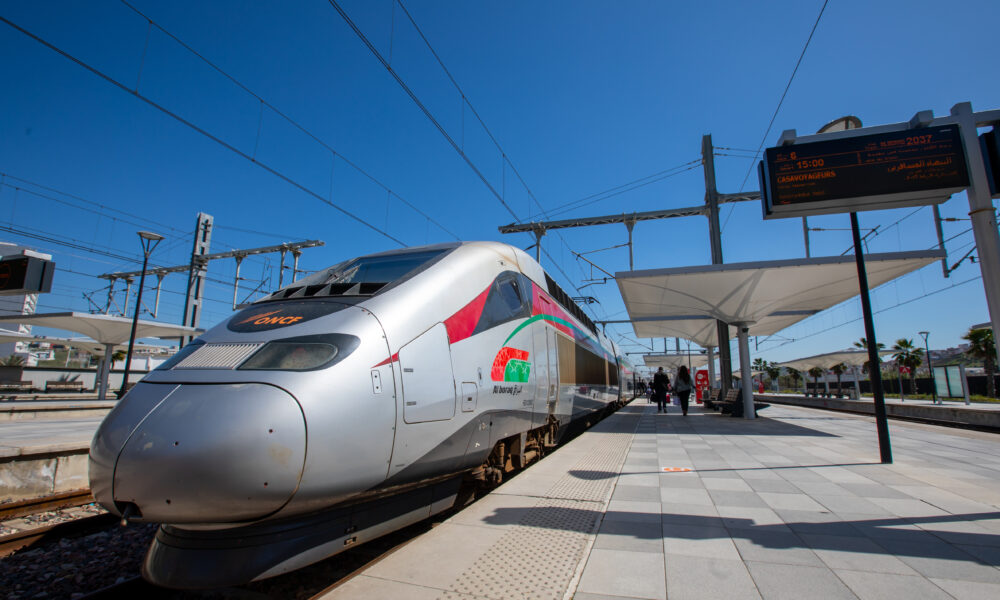
One year after its launch, the high-speed rail project linking Kénitra and Marrakech is making strong progress, according to ONCF.
The project was officially launched in April 2025 by King Mohammed VI. Since then, work has moved forward steadily as part of a major national railway development plan.
According to ONCF, land acquisition is now complete, and most of the required land has been cleared. This shows effective coordination between all parties involved.
Construction work is advancing well across the entire 430-kilometer route. Earthworks and major engineering structures are progressing as planned. So far, nearly 20 million cubic meters of earth have been moved.
Significant progress has also been made on infrastructure. Around 15 viaducts are currently under construction, along with three covered trenches located near Casablanca Airport, Zenata, and Aïn Atiq, with a total length of 1.5 km. In addition, 92 bridge-related structures are underway.
Railway equipment installation is also on track. So far, about 2.5 million tons of ballast, 800,000 tons of sleepers, more than 100,000 tons of rails, and 220 track switches have been prepared for the project.
Work is also ongoing on existing rail lines, where track installation is actively progressing. Meanwhile, signaling systems are being prepared for deployment on schedule.
Regarding passenger stations, the architectural designs have been finalized. Construction is being carried out in phases, with the first phase starting in early 2026. All stations are expected to begin construction by July 2026.
Beyond infrastructure, the project is also boosting Morocco’s economy. Around 150 companies are involved, with nearly two-thirds being Moroccan firms. This helps strengthen local expertise and industrial capacity.
This railway program is part of a broader plan to modernize Morocco’s rail system. The total investment is 96 billion dirhams. It includes 53 billion dirhams for the Kenitra–Marrakech high-speed line, 29 billion dirhams to purchase 168 trains, and 14 billion dirhams to maintain and improve the existing rail network.
Read Also: Morocco positioned as African model in tourism innovation, UN Tourism says