








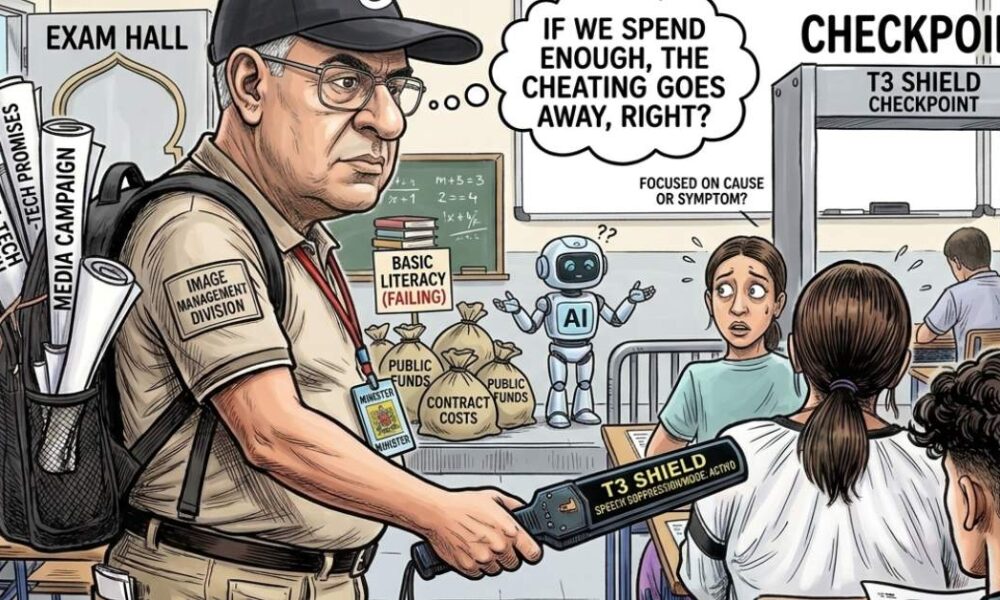
 Morocco's 2026 Baccalaureate exams became the focus of controversy after the introduction of electronic anti-cheating devices in examination halls.
 Morocco’s 2026 Baccalaureate season opened with an ambitious promise: for the first time in the kingdom’s history, artificial intelligence and electronic detection devices would be deployed inside examination halls to combat cheating among the 520,000 candidates sitting the national exam.
Table Of Content
Presented by Education Minister Mohamed Saad Berrada as a technological breakthrough capable of detecting hidden mobile phones and concealed earpieces, the devices were intended to strengthen the integrity of the examination process. Within days, however, the initiative had become the centre of a growing controversy.
When Exam Halls Start to Feel Like Checkpoints
The debate surrounding Morocco’s anti-cheating campaign quickly expanded beyond the effectiveness of the devices themselves. For many critics, the issue was whether examination halls were beginning to resemble security checkpoints rather than spaces of learning and assessment.
The “Chabiba Madrassia” Association condemned what it described as an atmosphere in which all candidates were treated as potential suspects before a single answer had been written. While acknowledging that surveillance measures may be legitimate in principle, the association argued that their implementation created additional psychological pressure at one of the most decisive moments in a student’s academic life.
The group called on the ministry to establish clear guidelines ensuring that monitoring tools are used in ways that preserve student dignity.
Doubts Over the Technology
As candidates left examination centres across Morocco, videos circulated on social media raising questions about the effectiveness of the T3 Shield device.
Students reported doubts about whether the equipment could actually detect electronic cheating tools as advertised. The contrast between the ministry’s pre-exam announcements and reports emerging from examination centres quickly became a focal point of public discussion.
Critics Say the Problem Runs Deeper
Civil society organisations argued that cheating in Morocco is not primarily a technological problem requiring a technological solution, but a structural issue rooted in broader challenges facing the education system.
The Moroccan Forum for the Right to Education pointed to ministry figures showing that 70% of sixth-grade pupils do not master basic learning competencies and that 90% of third-year middle school students fail to command their curriculum. In that context, the organisation argued, deploying detection devices without addressing underlying learning challenges risks becoming a distraction rather than a solution.
The forum maintained that the roots of the problem lie deeper than what any device can detect at the classroom door.
Questions Over Public Spending
The controversy also extended to the procurement of the devices.
A rights organisation called on the Supreme Audit Institution to open an urgent investigation into the contract used to acquire the equipment, claiming that it had cost the public purse hundreds of millions of centimes.
The organisation questioned whether the initiative was primarily aimed at educational reform or whether it had become a lucrative public procurement exercise.
Parliament Joins the Debate
Political criticism intensified when opposition MP Fatima Tamni of the Democratic Left Federation publicly challenged the ministry’s handling of the initiative.
Writing on social media, she argued that the ministry had become more skilled at managing its public image than managing education itself. According to Tamni, officials promoted the devices as though Morocco’s educational challenges could be solved at the push of a button.
She argued that the result was confusion, unanswered questions, and growing doubts about technology acquired with public funds. More broadly, she accused the ministry of prioritising announcements and media attention over measurable educational outcomes.
The Larger Question
The controversy surrounding Morocco’s 2026 Baccalaureate has exposed a broader debate about how the country should address academic dishonesty.
Critics acknowledge that cheating remains a genuine challenge, driven by social pressure, grade-focused incentives, and weaknesses within the education system. However, they argue that electronic detection devices target the symptom rather than the cause.
Several organisations have instead advocated for competency-based assessment models that make information-transfer cheating less relevant, while recommending that security checks be conducted at school entrances rather than inside examination halls.
Morocco’s commitment to protecting the credibility of its national qualifications is not in question. What remains contested is how that credibility should be protected — and whether the balance between security and student experience has been properly struck.