






 Millions of pilgrims are set to perform Hajj this season under temperatures forecast to reach 47°C
 Every year, millions of Muslims converge on Mecca to perform one of the most physically demanding acts of faith on earth. This year, they will do it under temperatures that Saudi Arabia’s own meteorological authority describes as ranging from hot to extremely hot — and the numbers are not reassuring.
Saudi Arabia’s National Center of Meteorology has forecast maximum temperatures between 44°C and 47°C during the opening days of the 1447 Hajj season, with overnight lows offering little relief at 28°C to 31°C. Dust-laden surface winds will compound the conditions throughout daylight hours. Then, from the Day of Arafat through the 13th of Dhul Hijja — the spiritual peak of the pilgrimage — temperatures are expected to ease only slightly, ranging between 42°C and 44°C, while humidity climbs to 55%. The Center has also flagged the possibility of thunderstorm clouds forming over the Taif highlands, with potential to push dust storms into the Holy Sites.
The backdrop to these figures is grim. In 2024, over 1,000 pilgrims died — the majority Egyptian — when temperatures exceeded 51°C (Deutsche Welle). In 2023, more than 1,721 heat exhaustion cases were recorded in a single day, with temperatures reaching approximately 48°C (Deutsche Welle). This season arrives once again at the peak of the Saudi summer.
Arafat: The Hardest Test
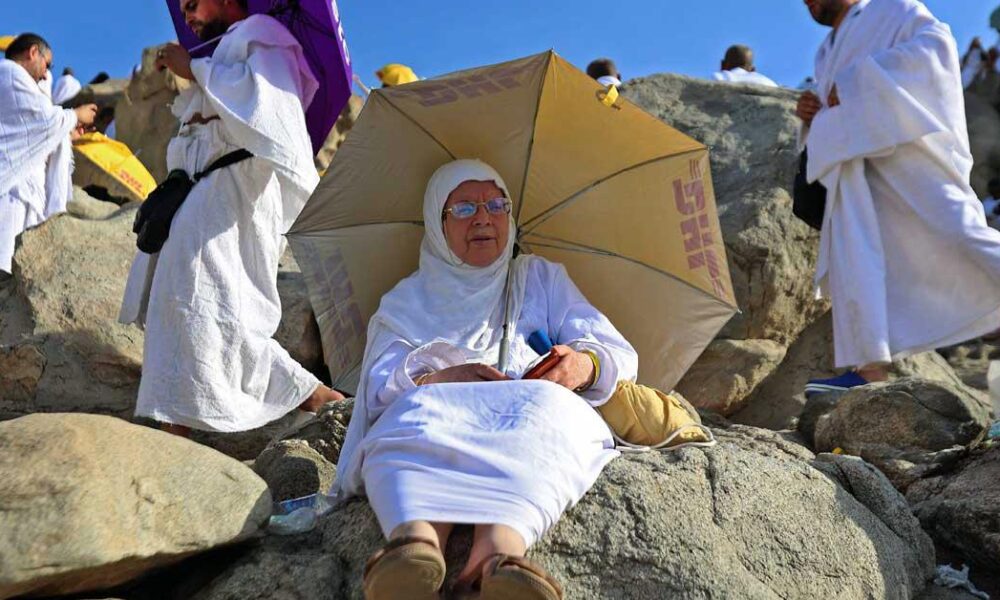
Of all the rites, the Standing at Arafat is both the spiritual core of Hajj and its most physically grueling moment. Pilgrims must be present within the plain’s boundaries for a prescribed period — outdoors, under open sky, in what this year could be 44°C heat combined with humidity reaching 55%.
The Saudi Ministry of Health has responded with a public awareness campaign under the slogan “Hajj in Health”, urging every pilgrim to carry what it calls the protective trio: an umbrella to block direct sun exposure, a face mask to guard against respiratory infections in crowded spaces, and a water bottle to maintain constant hydration. The directive is simple. The conditions that make it necessary are not.
A System Built for the Worst
Saudi authorities have expanded the use of cooled rubberized road surfaces to reduce ground temperatures, deployed surveillance drones to monitor crowd movement, and banned LPG cylinders from pilgrim accommodation centers — a precaution drawn from the 1997 Mina fire that destroyed 70,000 tents. Air-conditioned transport and cooling systems in gathering areas have been reinforced, and a 20,000 riyal fine now applies to anyone attempting to perform Hajj on a visit visa.
The National Center of Meteorology’s field monitoring network covers 59 automatic weather stations, 19 mobile units, 3 fixed radars, and a mobile radar, alongside upper-atmosphere observation posts. A newly launched media and digital communications center will broadcast weather bulletins in multiple languages across 15 platforms using AI-assisted tools.
The infrastructure is serious. The challenge is more serious still. Climate change is not making these seasons easier — it is making them harder, year after year. For the millions who arrive in Mecca this season carrying decades of faith and a water bottle, the margin between devotion and danger has never been thinner.