




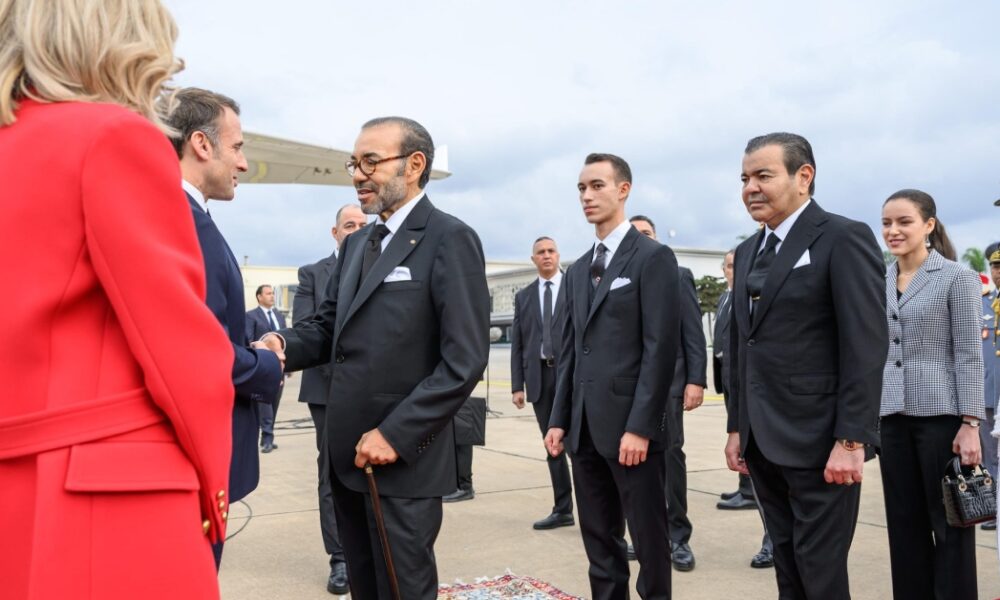
 "A seismic shift" — IFRI's Antil reveals what the Morocco-France treaty really contains, exclusively to 24SAA/MT.
 “A seismic shift in the deep structure of French foreign policy since the founding of the Fifth Republic”. That is how Dr. Alain Antil, head of the Sub-Saharan Africa Centre at IFRI and one of France’s leading experts on African diplomacy, describes King Mohammed VI’s upcoming visit to Paris — in an exclusive statement to 24SAA/MT.
The treaty to be signed will carry the designation of “irrevocable comprehensive strategic partnership” — the first of its kind France has ever concluded with a non-European state — reflecting what Antil calls a belated but decisive French recognition that Rabat is no longer a dependent partner, but an indispensable geopolitical pivot for Europe’s southern flank, energy security, and migration.
Four unpublished pillars — revealed exclusively
The treaty text — currently under confidential negotiations — rests on four inseparable axes. First: a joint security framework with real-time intelligence sharing and a permanent joint cell for cross-border crime and cybercrime. Second: an integrated economic mechanism granting Morocco preferential access to French markets in renewable energy, phosphates, and food security, in exchange for French investment in Morocco’s digital infrastructure and smart ports. Third: a smart migration protocol recognizing Moroccan sovereignty over transit flows and replacing punitive surveillance with a shared development fund. Fourth: a judicial and consular chapter creating specialized investment courts, accelerating procedures for Moroccans in France, and — most strikingly — establishing a preferential immigration status for Moroccans, which Antil describes as “revolutionary in traditional French diplomatic practice”.
France is no longer looking for a partner to implement its policies. It is looking for an ally to co-author the future.
— Dr. Alain Antil, IFRI · Exclusive statement to 24SAA/MT
Why France moved — and what comes next
Faced with Russian and Chinese expansion in Africa and the collapse of French influence in the Sahel, Paris recognized that Morocco holds irreplaceable leverage — through its geographic command of the Mediterranean and Atlantic straits, its active crisis diplomacy, and its modern military capabilities. The treaty was deliberately designed to align with the Elysée’s push for European strategic autonomy, making it a tool to open wider EU-Morocco partnerships under a bilateral umbrella exportable regionally.
On implementation, Antil told 24SAA/MT that the joint high commission meeting planned for July will be decisive — translating treaty provisions into executive programmes with timelines, budgets, and annual evaluations. Priorities: modernizing the 1996 economic cooperation agreement, launching a defense partnership including dual-use technology transfer, and creating a unified digital platform for migration and sustainable development. The royal visit to Paris, he concluded, “will not be a celebration of the past, but a declaration of the birth of a new strategic era”.