




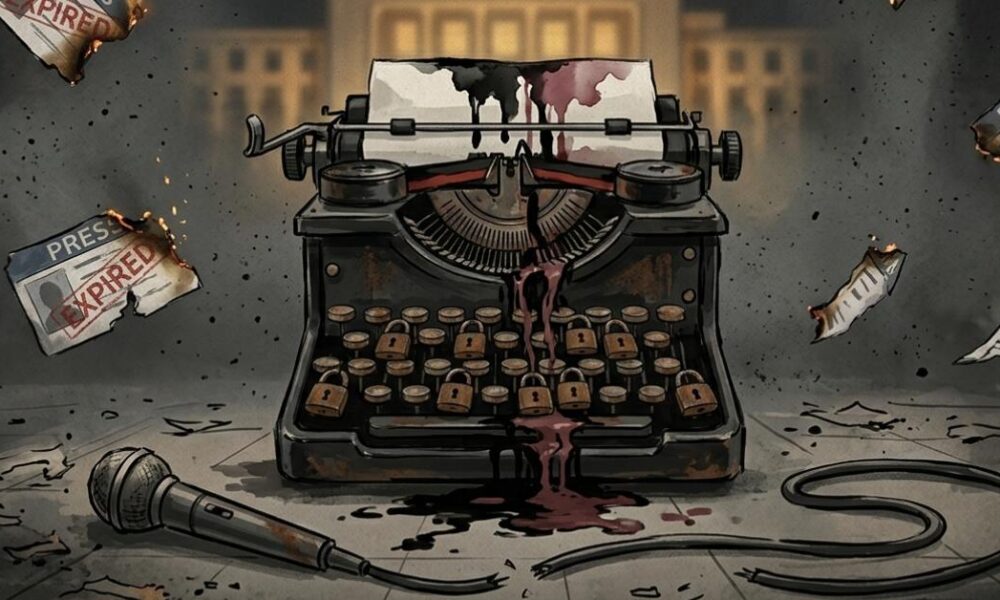
 In Morocco, the press card has become a licence for hardship — and the ink, it seems, is running dry
 By Oussama Belfakir
The third of May was meant to be a celebration — a day when Morocco pauses to honour the written word and the freedoms hard-fought to protect it. Instead, it has quietly become something else entirely: an annual ritual of reckoning, a mirror held up to a media landscape that staggers between the hammer of reckless government decisions and the anvil of procedural paralysis.
Each year, Press Freedom Day arrives on cue — and so does the official script. Polished slogans about reform fill the airwaves, while the men and women who actually write the news sink deeper into a swamp of marginalisation. The rights the constitution promised them exist on paper; in practice, the current government has quietly buried them.
Moroccan journalism is in freefall, and the government bears no small part of the blame. In a precedent as strange as it is troubling, journalists have been effectively reduced to de facto employees of the Ministry of Communication — waiting, month after month, for a public subsidy to land in their accounts. Sometimes it does. Sometimes, as with April’s salaries, it simply does not. One might almost suspect that Minister Bensaid’s ministry derives a certain satisfaction from the spectacle — as though the suffering of those who practise the most demanding of trades were a feature, not a flaw.
This corrosive dependency has done something far worse than delay a paycheck — it has hollowed out the journalist’s independence. The reporter’s dignity, once a professional given, now hangs by the slender thread of government budget moods and the shifting winds of political loyalty.
The press card, once a symbol of craft and accountability, has been reduced to a licence for hardship — a passport to precariousness with no guarantees on the other side.
A Profession Held Hostage
Moroccan journalism is unwell — and has been for some time. It is in the grip of a prolonged and painful labour that has produced nothing but fragile institutions. The “militarisation” of regulatory frameworks, combined with the systematic exclusion of working journalists from shaping the rules that govern them, has delivered a National Press Council that watches more than it shields, and polices the void more than it cleanses the profession of the rot within.
The press card, once a symbol of craft and accountability, has been reduced to a licence for hardship — a passport to precariousness with no guarantees on the other side. Meanwhile, journalists find themselves in an absurdly unequal contest with armies of influencers who devour advertising revenues without scrutiny or obligation, leaving serious media houses to wrestle alone with the ghost of insolvency and the weight of unpaid debts.
Reality has a habit of exposing hollow slogans. The digital revolution, heralded as journalism’s great salvation, has revealed itself to be something closer to its executioner — an era in which artificial intelligence and viral misinformation corrode the credibility of the news with a speed no regulatory framework has managed to match.
What we are witnessing is, at its core, an absurdity. Press freedom is not a constitutional clause to be framed and hung on a ministry wall — it is a lived reality, measured in dignified working conditions and genuine legal protection. The talk of “international rankings” and “transparency” and “editorial independence” rings hollow so long as publication disputes are funnelled through criminal courts, and so long as defamation charges remain a loaded weapon, cocked and ready for any journalist bold enough to follow a story where it leads.
Media institutions, too, are not without blame. They must stop treating journalists as line items in a subsidy ledger. Morocco has 3,800 accredited journalists — the majority of them living on the edge of professional survival. To allow that reality to persist is not a management failure; it is a wound inflicted on the democratic process itself.
The responsibility is collective — but the heaviest share belongs to those who engineered a reform with no roots in the actual newsroom. A free press is not one that survives on the charity of public subsidy. It is one where journalists hold the pen and the purse, and answer to their readers before anyone else.
When the Watchdog Has No Teeth
When the National Press Council was founded in 2016, the profession dared to hope. Here, at last, was an institution built to bring order and integrity to a craft in need of both. That hope has since curdled into disappointment. Rather than elevating the profession, the Council has deepened its chaos through decisions that betray a striking absence of professional instinct. Its most damning failure: hundreds of journalists today carry expired press cards, rendering them technically unlawful practitioners — a precedent that does not merely embarrass the Fourth Estate. It strips it of its legitimacy.
The scene today is, frankly, a pitiful one. The state distributes millions of dirhams in public money under the banner of media support — and yet the journalism that results barely rises above the surface. Rigorous analysis is absent. Field reporting has all but vanished. The great genres that once formed the backbone of the craft — the long investigation, the ground-level dispatch, the deeply sourced analysis — have been quietly retired. Investigative journalism, that most vital of public services, is now a relic. A memory. A word people use to describe something that used to exist.
The logic of cronyism has seeped into every corner of the profession — including the mundane business of event coverage, where press invitations and accreditations are handed out not on merit, but through webs of personal connections and political favour. It is a practice so normalised here, and so unthinkable in countries that genuinely respect their press, that its very ordinariness has become the most damning indictment of all.
Public money flows generously toward outlets that offer little beyond noise and shallow content, while the profession itself remains wide open to opportunists who have turned the regulatory vacuum into a personal revenue stream — and, in doing so, have done lasting damage to the public’s ability to tell truth from fabrication.
That this situation persists is not merely a policy failure — it is a mark of shame on the current government’s record. Freedom and transparency are not phrases to be deployed at press conferences. They are conditions to be created and defended. And they mean nothing — absolutely nothing — as long as journalists are denied their most elementary rights, and encircled by regulatory bodies that have proven themselves catastrophically unfit to protect the press from its slow surrender to mediocrity and dependence.
A free press is not one that survives on the charity of public subsidy. It is one where journalists hold the pen and the purse, and answer to their readers before anyone else.
So this third of May, spare Moroccan journalists the congratulations. Give them something worth more: their dignity. Return the profession to those who built it, who believe in it, and who bleed for it. There is more to be said — and it will be said — for as long as the wound remains open.